In September 2024, a storm called Boris had its way with towns and villages across Central and Eastern Europe. In many communities, it dropped a month’s worth of rain in only twenty-four hours.
Romania was not spared and people in Galati county were hit the hardest. Thousands of homes were severely damaged and hundreds of people displaced. Seven died.
“You work a lifetime, gather a little, set aside. And then you wake up with nothing—not even salt” says Vasile Mirica, a 81-year-old from Slobozia Conachi. “What can you do? You sit like a beggar, waiting for someone to bring you a plate of food or a can.”
These are just glimpses of the countless tragic experiences that the floods left behind, stories of people coping with the aftermath, and trying to rebuild their lives amidst devastating losses. But they also serve as a stark reminder of the ongoing challenges posed by climate change, and the urgent need for systemic change, including better infrastructure and preventive measures to mitigate the impact of future floods or other natural disasters, especially at a time when these natural phenomena tend to become more frequent and more severe.
Beyond the waters 01
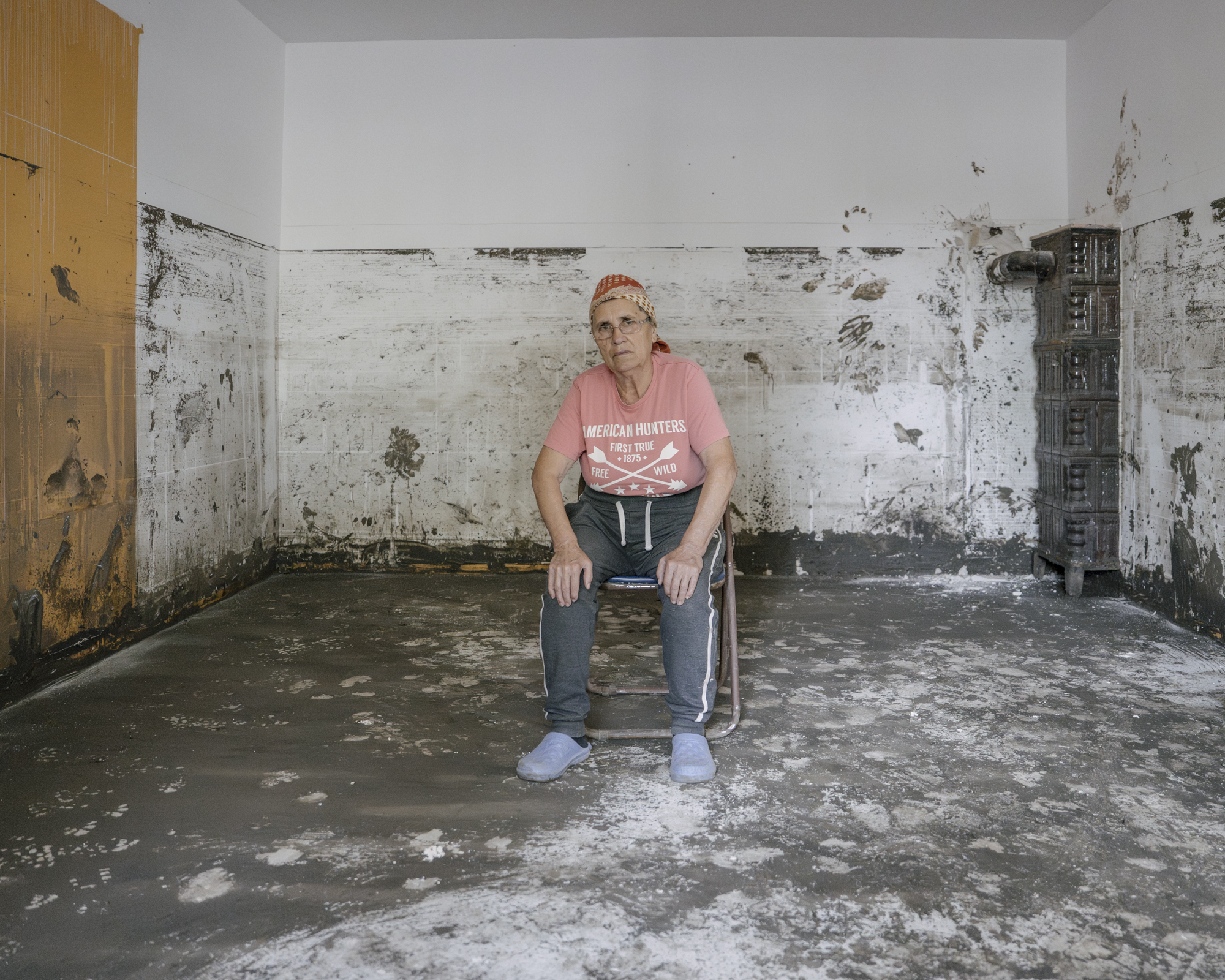
Neculina Ilie, 71 years old in her devastated home in Costache Negri, Romania after the Boris storm had hit the area.
“I used to live here. From now on, God knows where I’ll live,” says Neculina Ilie about the place she called home for so many years. “We can’t rebuild the house here anymore.”
At 11:30 p.m., when the floodwaters came, she was alone at home. She hoped the water would remain shallow, like in 2016. Preparing for the worst, she took all the rugs from the floor, piled them on her bed—a large double bed built into the furniture—and climbed on top. When the water rose to the level of the bed, she took out all the comforters and pillows from the wardrobe, stacked them into a tower, and climbed on top again. She only managed to save her documents and her son’s laptop, holding them tightly to her chest.
“It started to rise, and rise, and rise,” Neculina recalls. “Everything in the house began collapsing: tables with TVs, wardrobes, beds—everything. Bang, bang. The water brought everything near me—the things I once had in my home. God, what else can I do? God, what do I do now that the water is coming?”
When the water reached her chest, she thought of climbing onto the wardrobe, hoping the bed would keep it stable. “I leaned against it and grabbed it with both hands—I even have pain under my ribs now from holding on like that. From 1 a.m., when the water rose so high, until 7 a.m., I stayed clinging there.”
She had no electricity or flashlight. Occasionally, she turned on her phone’s light so someone passing by in a boat might see she was inside. She kept doing this until daylight. When the water started to drop, she prayed, “Please, God, let it go down. Please, God.” But she was soaking wet and started shaking. “Oh no, I survived the whole night, and now I’ll die,” she thought.
She tried to find something dry to wear. She opened the wardrobe slightly and managed to pull out a tracksuit. When the water dropped to her feet, she changed out of her wet clothes and rubbed her muscles vigorously to warm herself.
When she opened a window and saw her grandson outside, he had brought her dry clothes. “Grandma’s okay,” she told them. “When the water goes down, maybe I can come out.” When the water finally subsided, they carried her over the debris. It was 7:30 in the morning.
For the clarity and presence of mind she displayed that night, Neculina thanks God. She believes it was His guidance that kept her safe. She prayed continuously, “God, stop the flood. God.”
Her neighbours believed she had died. So did her children. “One of them imagined that when he reached me, he’d find me bloated, floating in the water,” says Neculina. “That’s the image he had when he came home.”
The 71-year-old woman lives in Costache Negri, with a stream right behind her house. “I look at the stream from my house,” she jokes. The embankment has eroded and is now lower than it was before. Her only hope is that the authorities will fortify the stream or offer her a plot of land elsewhere in the village. “You can’t rebuild here because in a few years, it will happen again. This is the third time,” she says.
In 2013, after the first flood, she rebuilt her old house. With funds from the government and help from her children, she built a new one. No one warned her that this could happen again. “We kept calling the town hall and saying they needed to clear the stream. They came with dredging machines, raised the other side, made it high, and left us down low. Then they said they couldn’t access this area anymore because it had been worked on. The only way to get in was through the yards along the street. We said, ‘Fine, we’ll allow it. Bring the machines.’ Nothing came of it,” Neculina says.
In 2016, another flood came, but it only affected the lower annexes. “After that smaller flood, we didn’t give up. We went to the town hall; people came from Galați, from the environmental agency. We kept saying something needed to be done, but nothing was done. If they had fixed the stream, we wouldn’t have suffered like this.” She adds, “Now it’s too much—you’ve seen how high the water was.”
Every time it rains, her children worry. “Are there clouds?” they ask her. “Has the rain started? What kind of rain is it? Get out; don’t stay in the house,” they insist. “This time, they didn’t even sound the siren to warn us beforehand,” Neculina says. “Apparently, it was broken. If it had worked, maybe we could have left earlier. But how do you leave through water that’s already carrying you away?”
Neculina has lost everything. All her chickens. Her two parrots, drowned in their cage. Two dogs, whom she still searches for among the mud in her yard. All the furniture in her house. Plus, her son’s belongings, which he had stored there while renovating his apartment in Galați. A ton of corn purchased for the birds. The firewood her children had prepared to get her through the winter. She heard on the news that they’ll receive vouchers for appliances, but that’s not her priority. “Let them come with those if they want. But what about a house? Where do I live? I’ll manage to replace appliances later, but a house—where do I build it? Invest money here? It’s not possible.”
Neculina will spend the winter at her son’s home in Galați. “In the spring, if they allocate plots of land in a flood-free area, I’ll build again so the children have somewhere to visit,” she says. “And maybe I’ll live to see it. I’m 71 years old. I hope to live longer, if God wills it. That’s it. There’s no way to repair things here.”
Neculina is content to be given a plot of land anywhere in the commune. “I won’t go too far. If I leave here, my children will feel uprooted too. I don’t want to leave this area, but I need land, and maybe the town hall will think of us. With patience and God’s help, maybe they’ll prepare something for us. That’s all we can hope for.”
Costache Negri, Romania, September 25th, 2024
Beyond the waters 02
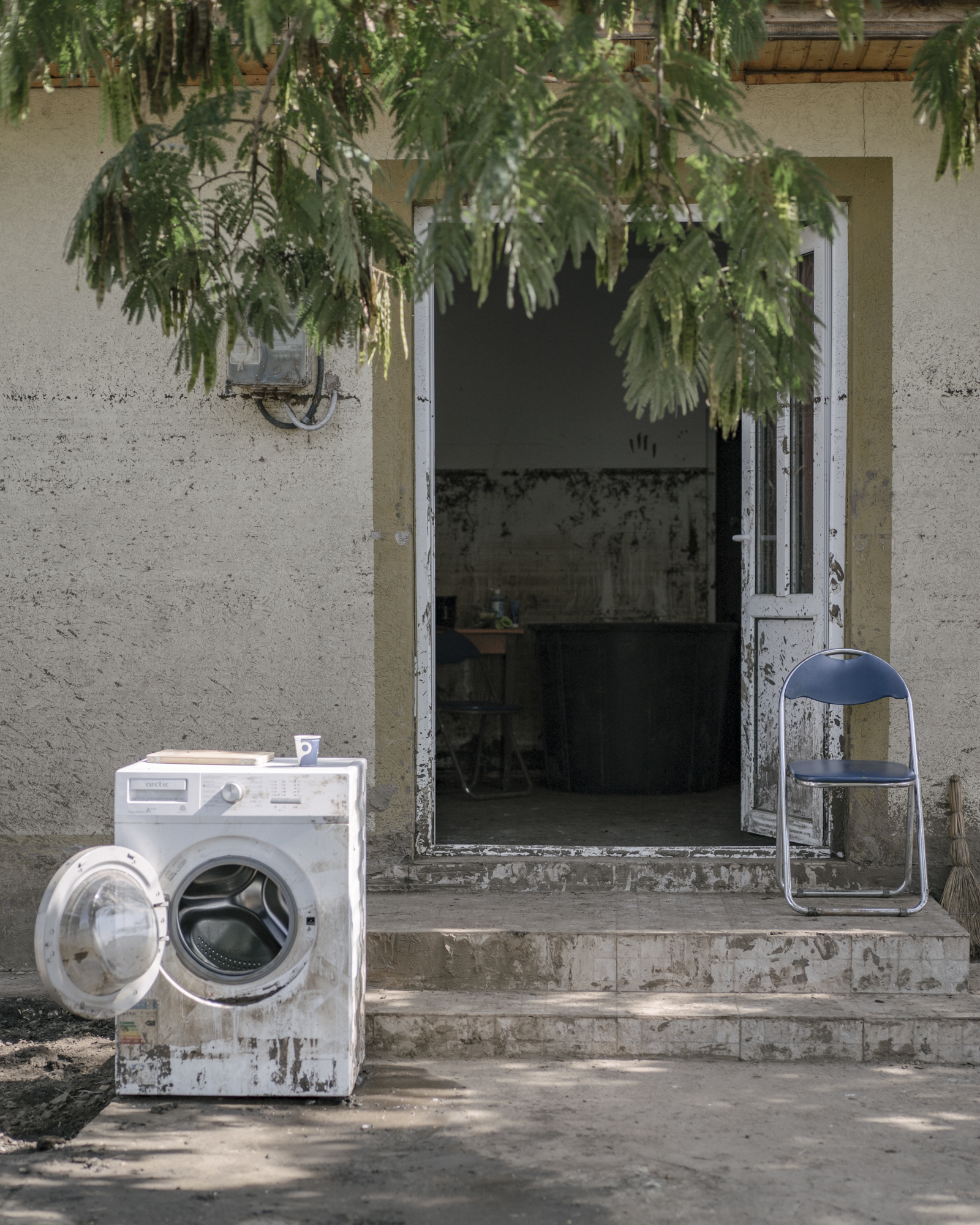
Outside Neculina Ilie’s flooded home in Costache Negri, Romania after the Boris storm had hit the area. In September 2024, the village where she lives has been hit by floods for the third time in the past 11 years.
Beyond the waters 03
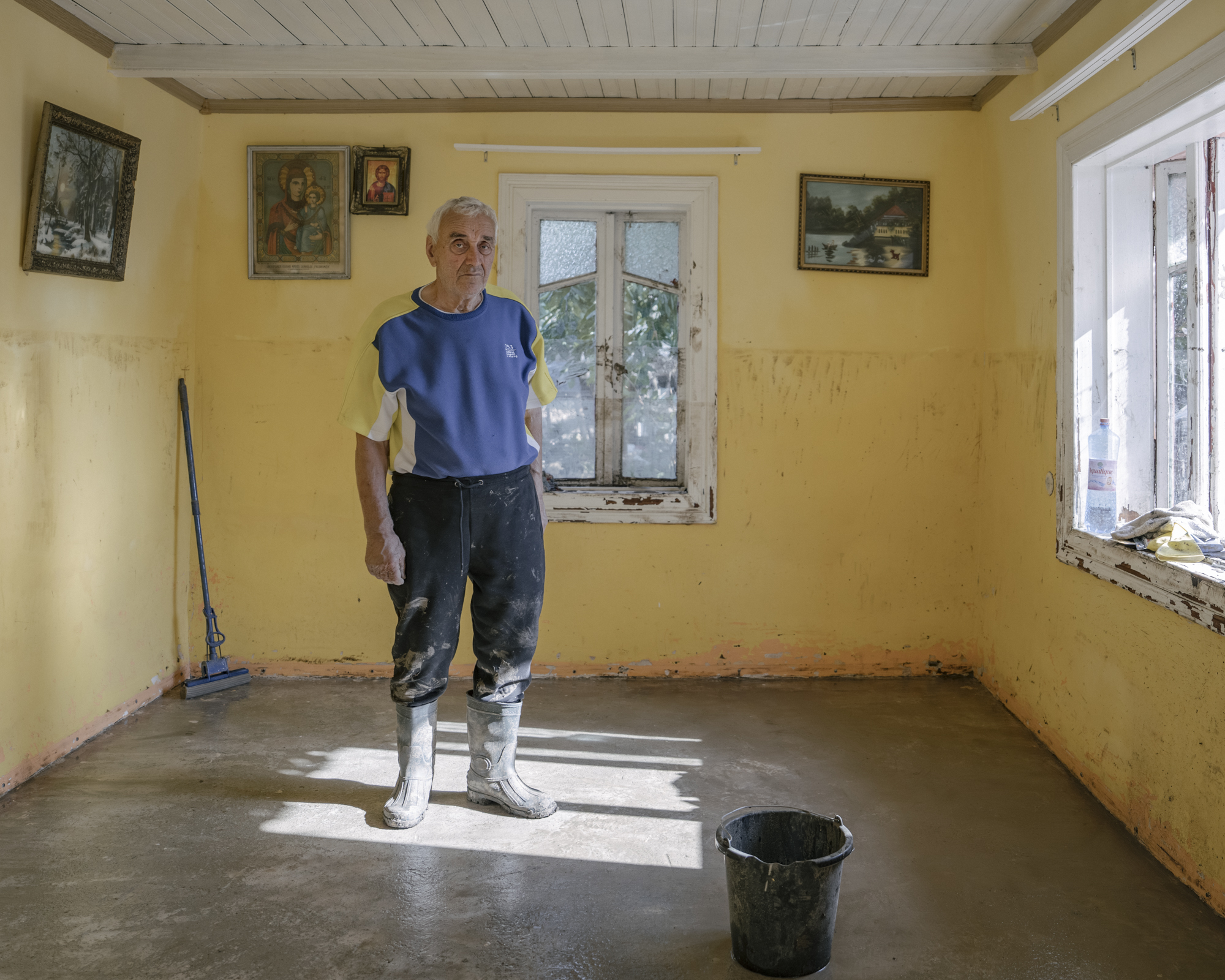
Vasile Mirică, 81 years old, in his flooded home in Slobozia Conachi, Romania after the Boris storm had hit the area.
Vasile Mirică was awakened by his daughter in the middle of the night, around one o’clock. “Dad, wake up, it’s grim outside.
There’s water in the yard.” He got up, saw the water, and realised it wasn’t just rain. “This is coming in; it’s muddy,” he thought.
His first thought was to save the poultry, lifting them to safety so they wouldn’t drown. By the time they returned, the water was
already entering the house. They fled to the street, moving higher up, near the school.
“Around three in the morning, the big wave came,” says Mirică. “It covered the car in the yard, everything—nothing was left. It
broke the fence, and a piece of the gate was carried away. That day, we had harvested grapes and crushed them, but nothing
remained. That first day was chaotic—no help, nothing. Everyone was disoriented, not knowing what to do.”
The real hardship, however, came after. They couldn’t salvage anything from the house. Everything was destroyed—furniture,
appliances, everything. Some soldiers helped them remove the worst of it.
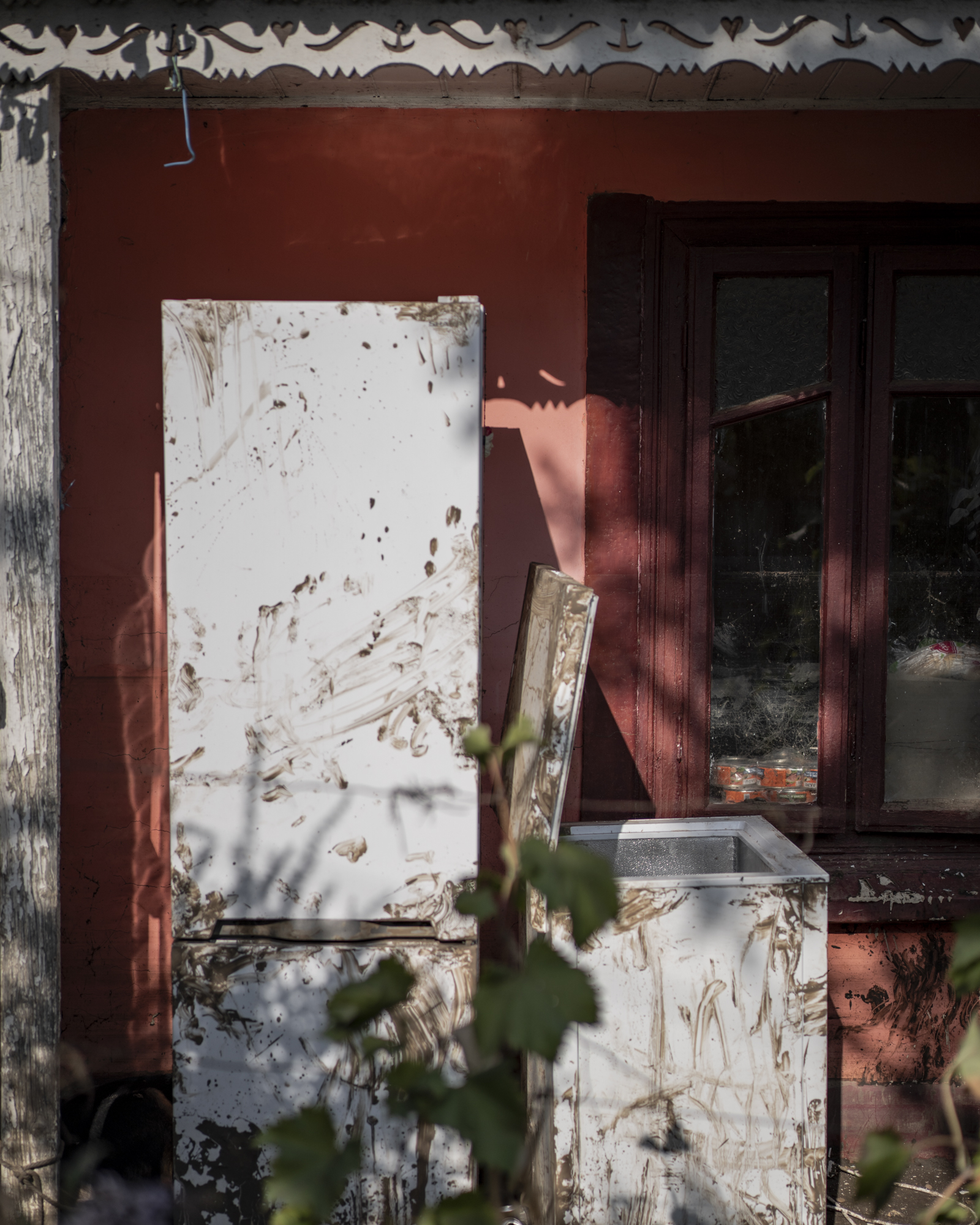
“Everything was ruined. We had two TVs, two washing machines—they’re gone,” Vasile recounts. “Two refrigerators and a
freezer. We had those because we kept many birds. That’s life in the countryside, and I liked having everything. I used to
slaughter and store meat in the freezer. My daughter would say, ‘Come on, Dad, I’m not here to take your things!’ But I liked
having it all stored. Whatever I wanted, I could find there.”
Out of 75 chickens, only five survived. The ducks and cats were saved. The two dogs were rescued before the floodwaters arrived.
“I pampered them, gave them cheap lunch meat, of course. I love them, both the dogs and the cats. You raise them from pups,
and you can’t help but care for them.”
Now his daughter is helping him clean—washing the walls, floors, and windows covered in mud. Vasile is unwell, and even a
small amount of work leaves him completely exhausted the next day. They also sought help elsewhere. “But often, when
someone came to help, I felt embarrassed to ask for this or that to be done,” the old man confesses. “I swear. I don’t know—it
feels like I’m making others do my work in my yard.”
The blue shirt he’s wearing is one of the few things he still owns. In the meantime, he’s received a few other items. “As for
clothes, oh Lord, there’s nothing to say. I would go to Galați, muddy, my daughter would wash my clothes, they’d dry overnight,
and I’d wear them the next day. It’s hard, so hard. Younger folks can rebuild, but what about me? What can I do?”
Like many others in the area, Vasile lost a lifetime’s worth of savings overnight. “You work a lifetime, gather a little, set aside. I
had everything, absolutely everything. And then you wake up with nothing—not even salt. What can you do? You sit like a
beggar, waiting for someone to bring you a plate of food or a can. What else can you do? That’s how it is. It’s tough, but we try to
get through it however we can. That’s our story as flood victims.”
Slobozia Conachi, Romania, September 24th, 2024
Beyond the waters 04
All the appliances of Vasile Mirică, an 81-year-old man from Slobozia Conachi, Romania have been destroyed when the flood hit his village in September 2024. They couldn’t salvage anything from the house.
Beyond the waters 05
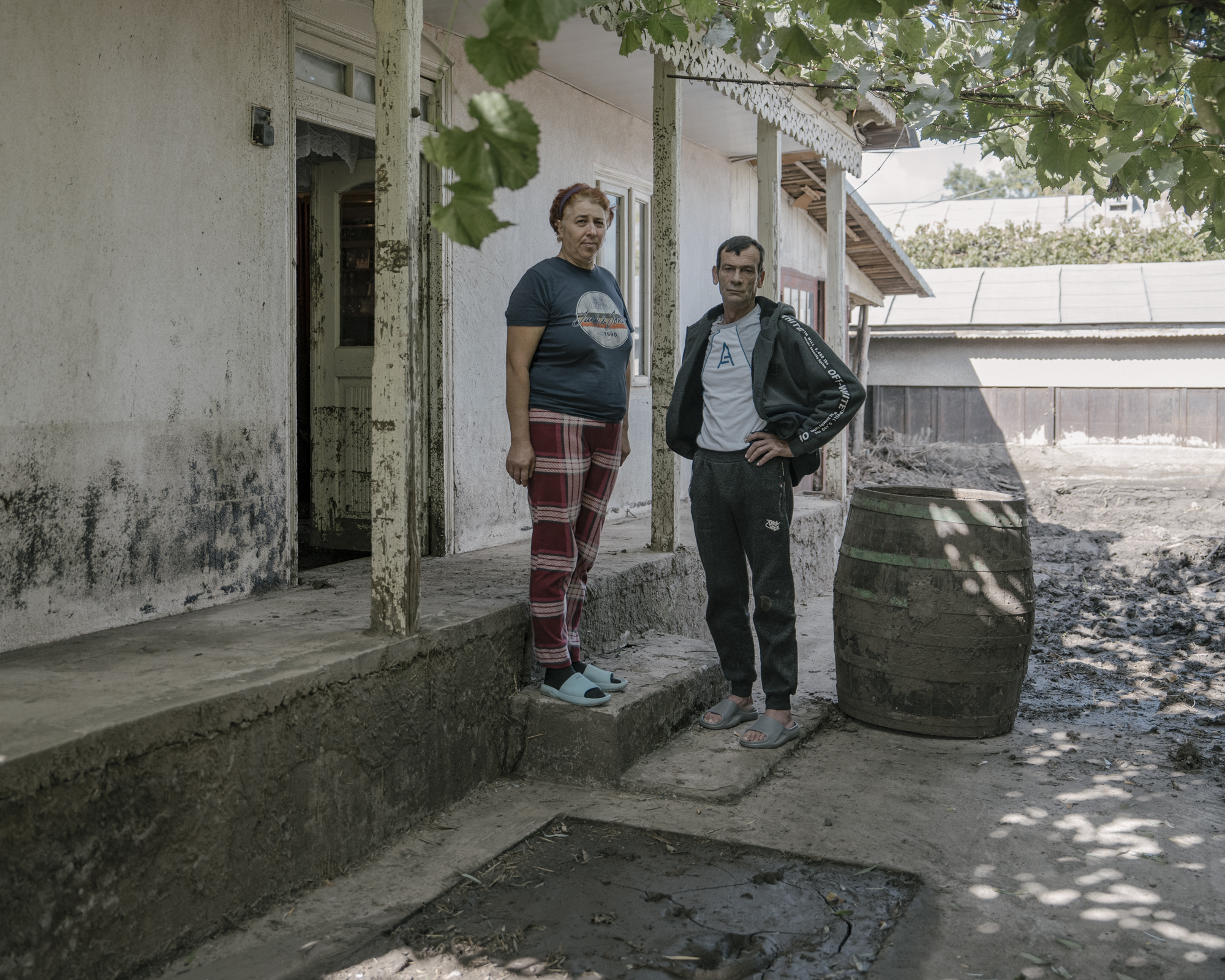
Aurel Manolache, 56 years old, and Lenuța Manolache, 52 years old in their courtyard in Pechea, Romania after the floods caused by Boris storm hit their village.
In the dead of night, Aurel Manolache’s phone buzzed with a loud alert. He read the Ro Alert message: take precautions, water is
coming, leave your home and move to higher ground. He opened the door to see what was happening. It had been raining
heavily for hours. He stepped outside, and there was water already. Ten minutes later, it was up to his knees.
“I got scared then,” says Lenuța, Aurel’s wife. “We didn’t even grab our documents. We stepped outside for a moment, thinking
maybe it would pass, just a little, but no—it overwhelmed us. We couldn’t return. The water came so quickly,” adds Aurel. “It
wasn’t just rising a bit. No… boom!”
On their street, there is an elderly woman living alone. Aurel recalls how he rushed into her house, fearing the water would
sweep her away. “She’s all alone. We treat her like a mother,” says Aurel. “I went into her house and got her out of bed. ‘Come
on, the water will take you and everything else.’”
The Manolache family spent the rest of the night in the street, on higher ground, with their neighbours. “We were all crying out
together.” They couldn’t return home until Monday at noon. “The water was still there,” says Aurel, “but at least it wasn’t rising
anymore.”
Inside their house, the water had reached one meter high. Mud streaks on the walls serve as a grim reminder, circling the rooms
like a belt. In one room, a bookshelf—the only piece of furniture not thrown out—holds things that were once new and
cherished, now caked in mud. In the yard, their chickens and ducks were gone.
“In my 56 years, I’ve never experienced anything like this,” says Aurel. “We’ve had three floods before, but never like this.” He
mentions the floods of 2013 and 2016 that also hit Pechea. “This was double what we saw 8-11 years ago.” He attributes the
severity to the nearby river not being cleared. “The reeds are two and a half meters high, and all the trash gets stuck there. That’s
why it overflowed onto us.”
“It shouldn’t have happened,” Lenuța adds. “People deserve to have a home, a place to stay. There are others whose houses
collapsed entirely. Where will they sleep? Some have children. What will they do? Where will they stay? Maybe they don’t even
have a room left to sleep in.”
Aurel insists he won’t leave his home, no matter what. Once the water receded, he laid down two rugs and slept on them. “After
two nights, I finally got some sleep.” He now has a bed from someone, and he sent his wife to sleep at their daughter’s house in
the same village. He’s tired, very tired. With the government aid they received, they bought appliances. “I got a washing
machine, and today I’m expecting a fridge because you need it. You have nowhere to keep food. What can you do with 10,000
lei? Nothing, honestly, nothing. Appliances are expensive. But I’m grateful we could replace the appliances. For the rest, what
can you do with 10,000? It’s nothing.” Lenuța is grateful for even that small help. “At least it’s something, enough to buy what
you need.”
The couple has three sons, all working in England. “They won’t come back now,” Lenuța says sadly. “Where would they come
back to? To have their house swept away entirely? Before, they talked about coming back to build homes. But now, what’s the
point? If they build, the water will just take it all.” She fears this wasn’t their last battle with the floods. “Do you think this is the
last one? There will be more water.”
Pechea, Romania, September 25th, 2024
Beyond the waters 06
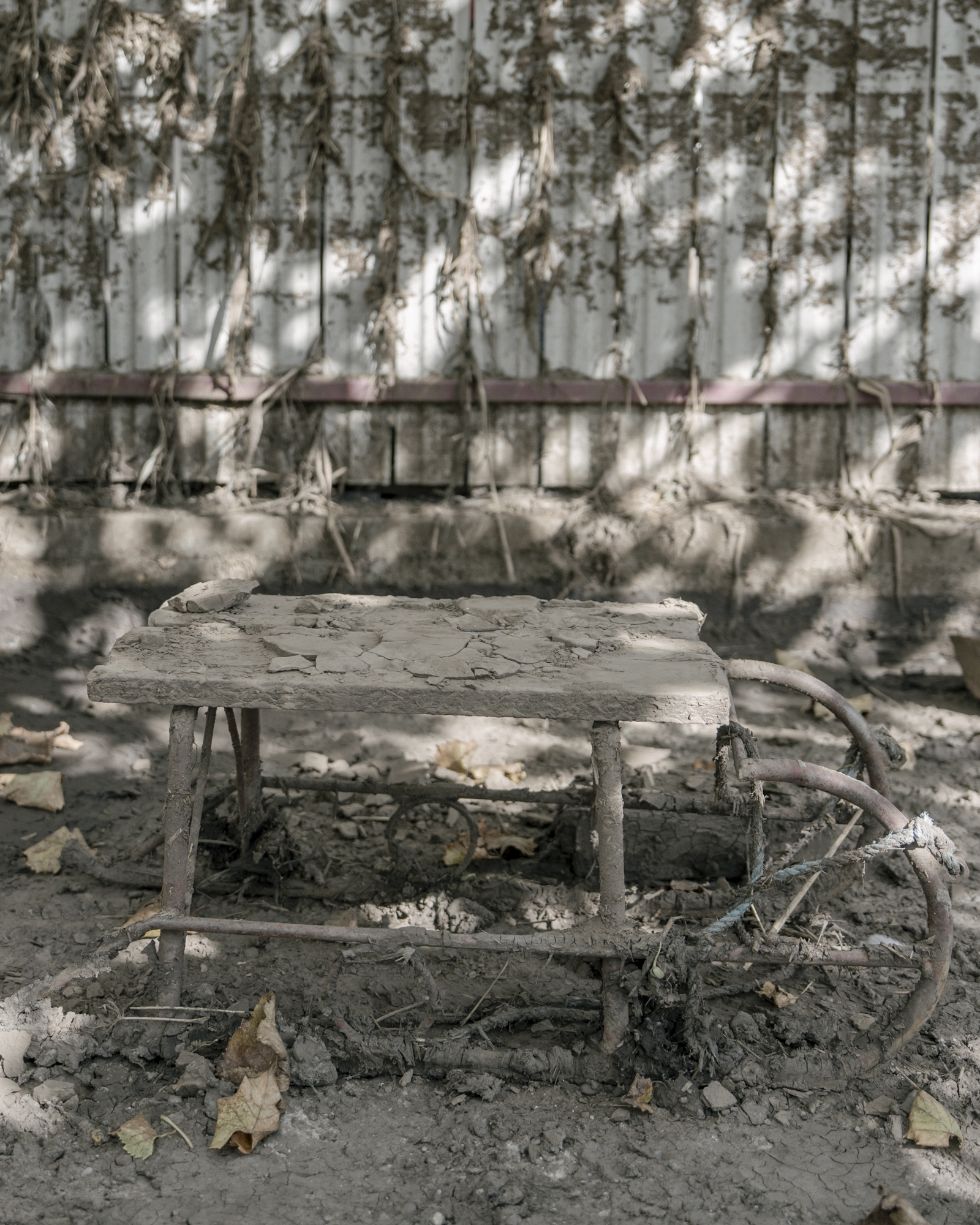
An old sleigh covered in mud in the Manolache family’s courtyard in Pechea, Romania after the floods caused by Boris storm hit their village.
Beyond the waters 07
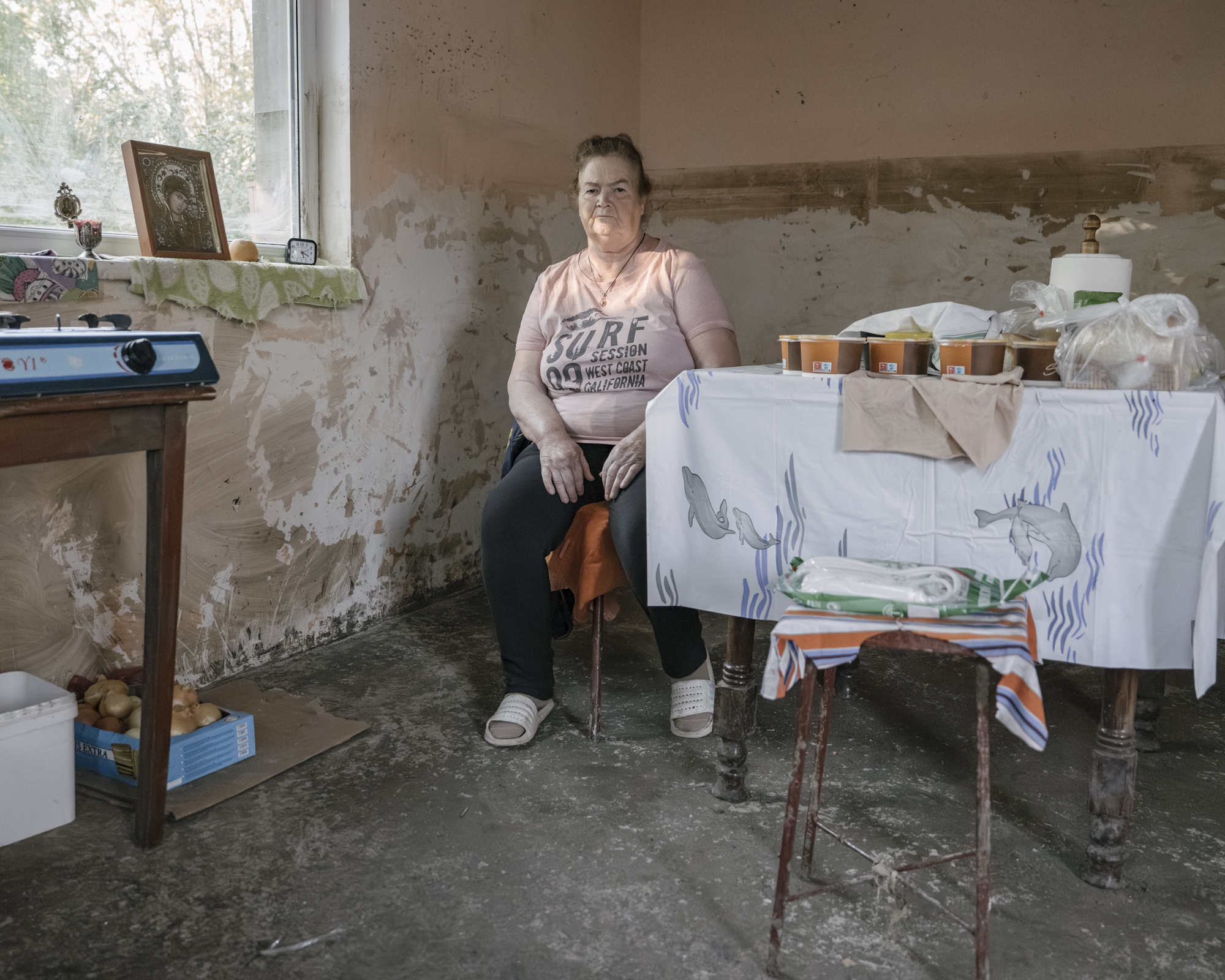
Ioana Marin, 71 years old, in her home in Slobozia Conachi, Romania after the floods hit her village.
“Up to my mouth—just two centimetres more, and it would’ve entered my mouth,” recalls Ioana Marin of the night of Friday,
September 13-14, when her birthplace, Slobozia Conachi, was hit again by floods—the third time in 11 years.
“Luckily, the boy who lives with us broke through to the attic, otherwise, I would have drowned.” She shows me a picture of her
house, where only the tin roof is visible above the water. “When the water came, it came all at once,” says Ioana. “With such
force that it destroyed the animal shelter here, the pantry there, and the ceiling collapsed. It ripped the doors off their hinges.”
It was the middle of the night when the boy living on their property woke her up. “Aunt Ioana, get up, something’s wrong, the
water’s coming.” She went outside in her nightgown. Seeing the water, she grabbed a robe and went to wake her husband and
son. By the time they all got outside, the water was up to their knees. “By the time they realised what was happening, the water
was already taking everything,” says Ioana. Her son ran to try to save the pigs. “But when he came back with the pigs and saw
me with water up to my mouth, he let the pigs go and came for me. Slowly, we managed to get to safety. It was so hard to open
the door because the water was already up to the windows. We had to climb out through a window.”
She describes how the boy broke through the paneling and boards leading to the attic with his bare hands, his fists bloody. Her
husband climbed up first, and with great difficulty, they pulled her up as well. By then, she was already unwell. “We sat up there,
soaked, for a long time—until the next day.” Without a signal, they couldn’t talk to anyone but had managed to call 112. Around
noon on Saturday, a helicopter circled above them but couldn’t rescue them due to the trees. Half an hour later, rescuers arrived
by boat. “They took us, and we found shelter wherever we could.”
It wasn’t until Monday that they managed to return home. “What can I say—when we saw what was here, we felt sick,” says
Ioana. “My husband nearly collapsed. I’m a bit stronger, but he’s sick.”
Their property is in ruins. The ceiling is on the verge of collapse. In one room, a device tirelessly tries to extract water from the
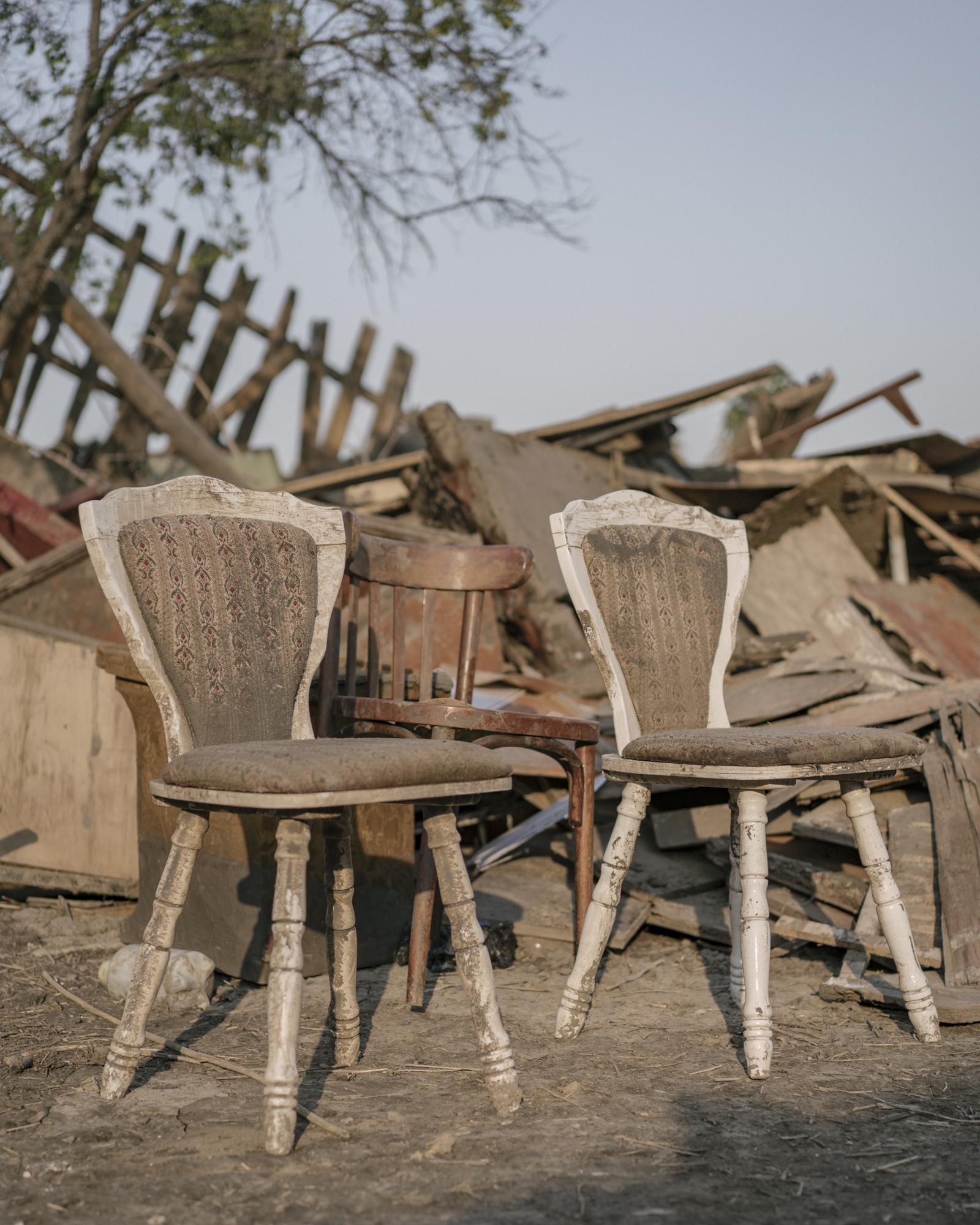
walls. The stoves are destroyed. Through the window, you can see the washing machine in the middle of the cornfield. The
tomatoes are all flattened. The pigs are gone, the horse is gone. Only 20 of over 100 birds remain.
“Horror. Horror. That’s what we went through,” says Ioana. “If the water was at my mouth… the panic. And to see my husband
like that. But may God grant us health to endure.”
Slobozia Conachi, Romania, September 24th, 2024
Beyond the waters 08
Destroyed shed and furniture in Ioana Marin’s backyard in Slobozia Conachi, Romania after the floods hit her village. During the flooding, one of her buildings was fully covered by the water, only the tin roof remaining visible.
Beyond the waters 09
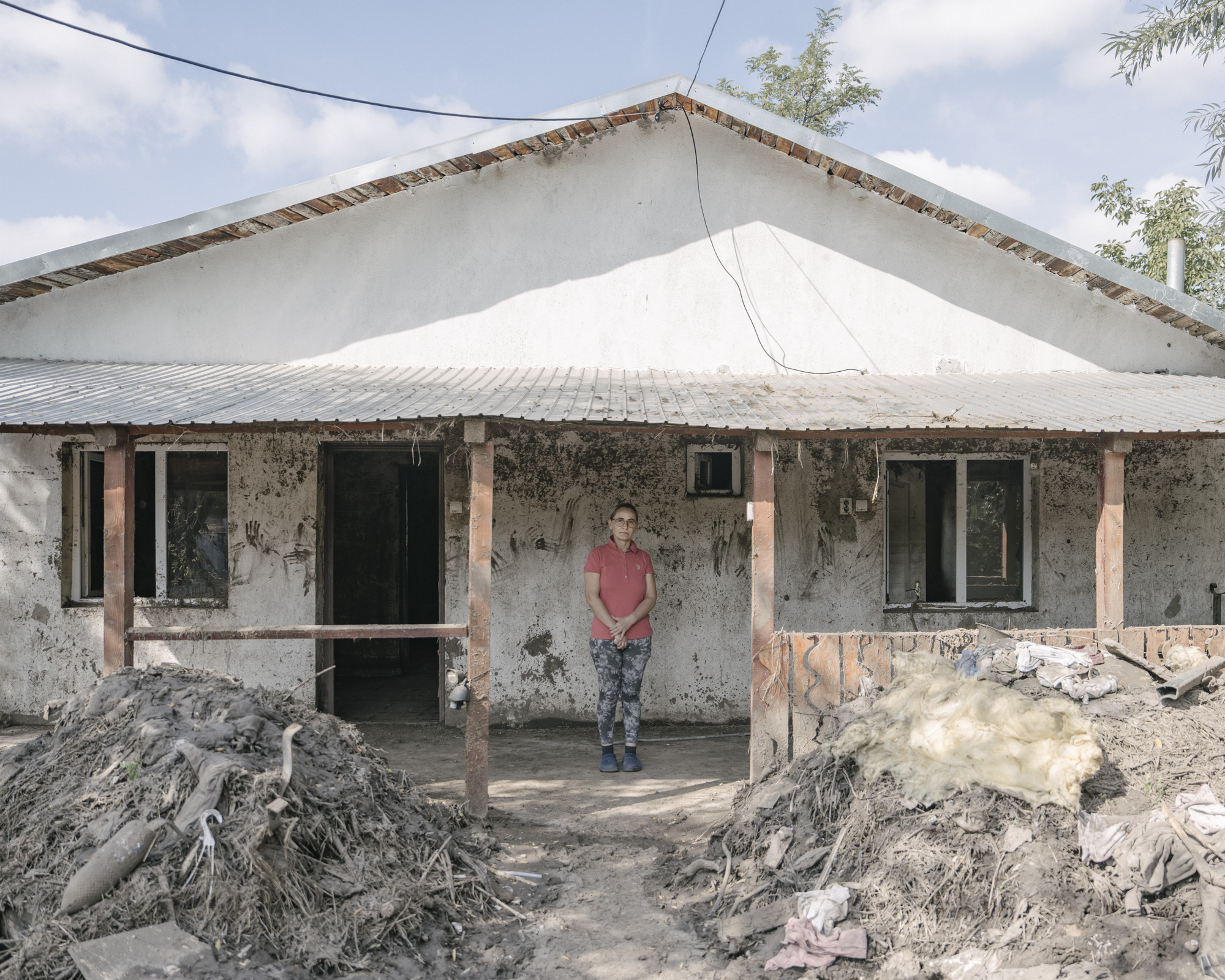
Monalisa Marin, 50 years old, at her brother’s home in Costache Negri, Romania after the floods caused by Boris storm hit her family’s village.
At six in the morning on September 14, Monalisa Marin received a message from her nephew: the area in Costache Negri where her family
lived was heavily flooded, and there was no news about her mother and brother. “At that moment, no one knew if they were still alive,”
Monalisa recalls. She tried calling, but the networks were down. She began searching for news from Romania to understand what had
happened. “Unfortunately, I couldn’t find much; I only knew that a great disaster had occurred.”
Monalisa Marin, a Montessori educator working abroad for ten years, booked the first flight home. By 4 a.m. the next day, she was in Tecuci.
“My nephew rented an apartment there, where he took my mother and brother. My mother was sleeping, and I didn’t want to wake her. I just
opened the door and looked at her,” Monalisa says.
Her brother recounted the events. He woke up to noise and the agitated barking of the dog. Getting out of bed, he stepped into water. He
quickly grabbed the dog and, alternating between walking and swimming, reached their mother’s house, which was slightly higher up near
the street. She was in her room, with water up to her knees. At first, she refused to leave the house, but when she finally agreed, it was too
late. “We can’t now,” he told her, “or we’ll both die.” The water was up to their necks. Taking her by the hand, they waded through the
darkness and cold water to another room, where a wardrobe had fallen onto a sofa. He broke through the ceiling with his bare hands and,
using the fallen furniture, helped his mother climb into the attic. Soaking wet, they stayed there until nearly noon.
“It was like a tsunami,” Monalisa’s brother told her about the scene outside the attic. “The water came from three directions, filthy and
incredibly powerful. The current was so strong, and the noise was deafening. It was terrifying.”
Costache Negri has experienced three floods in the past 11 years. “2016 was mild for us; the water was about 60 centimetres inside the house,”
Monalisa recalls. The word “mild” sounds chilling when paired with 60 cm of water. “2013 was quite bad,” she continues, “but the gardens and
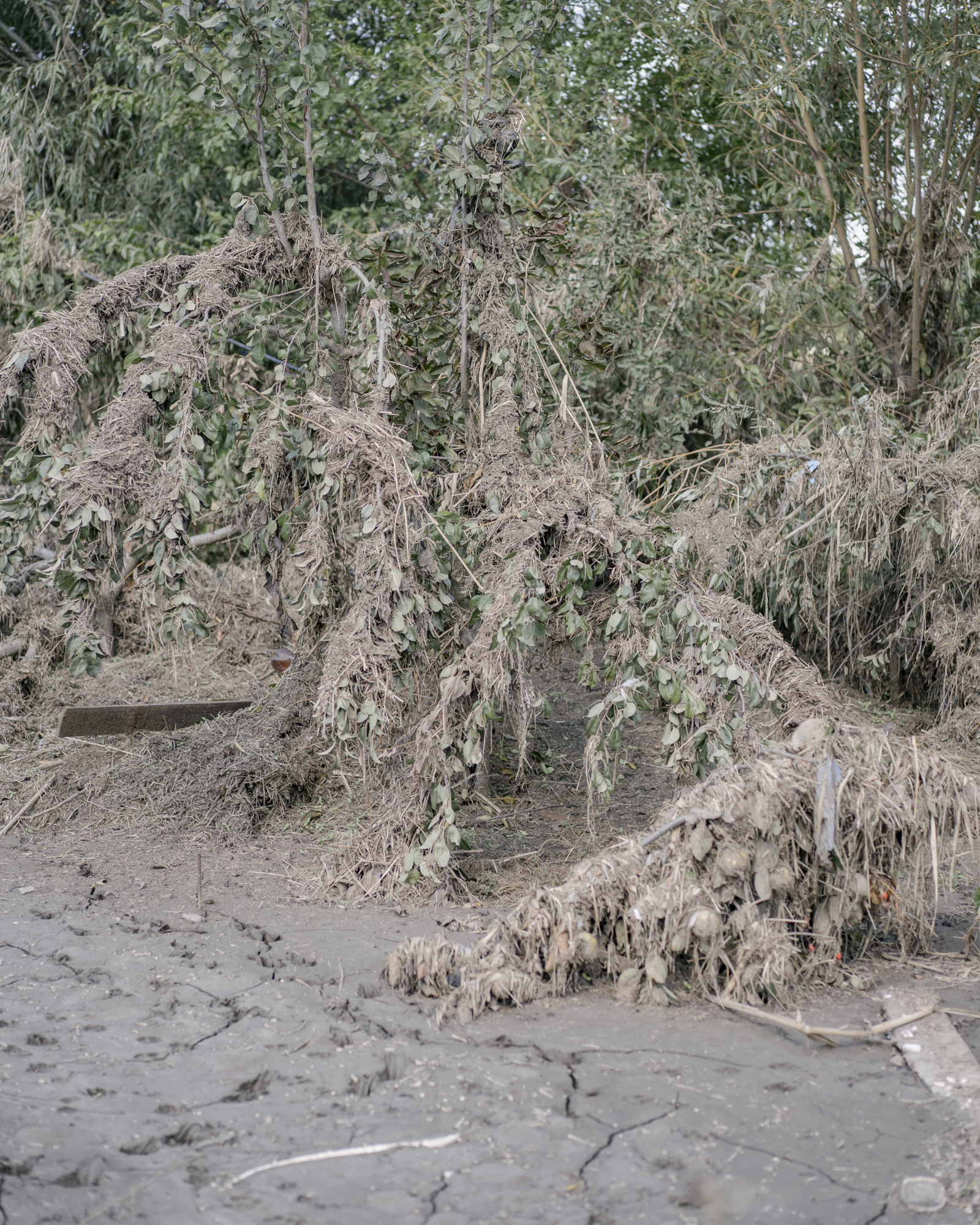
yards weren’t as affected. This time, it uprooted trees, destroyed all the fences. We have a concrete fence with a 60-centimetre foundation
underground, and it broke. Back then, we didn’t have anything left, everything was destroyed. But it wasn’t as terrible, as desolate, as
heartbreaking as now. This time, even the trees are gone—nothing is left standing.”
Since leaving the country, Monalisa has spent every summer vacation with her mother. She doesn’t travel; she stays with her. This summer,
she left Costache Negri three weeks before the flood. When she returned, everything looked desolate: water still covered the area, dead
animals lay everywhere, houses had collapsed, and mud was everywhere. Her family’s homes were filled with water and mud, the furniture
destroyed, and nothing recognisable from before remained. At her brother’s house, the water reached the attic. The house, built in 2010, was
brand new.
“It has survived three floods. Each time, we cleaned it, replaced the flooring, doors, windows—everything necessary. Each time, we lost
everything,” says Monalisa. “In 2013, we thought it was a one-time event. Okay, it rained, reservoirs overflowed, and this tributary wasn’t
cleared. We thought it wouldn’t happen again. No one told us that the Geru and Suhu rivers needed clearing, maintaining, and concrete
reinforcements. That they’d need millions of euros, which they didn’t have. We didn’t know this story.”
Now, every time it rains, people on Monalisa’s street live in constant fear. “No one sleeps even if it drizzles,” she says. “This summer, I stayed
there for over a month, and it rained a few times. I didn’t sleep at all. I walked around the yard, watching how much water was coming, how
much it rained. Everyone does the same, patrolling their yards and streets.”
She has since learned the area is officially declared a floodplain, unsafe, and at risk of flooding at any time. “The Minister of Environment even
said it,” Monalisa notes. All her neighbours, including her family, are planning to leave. “No one wants to live there anymore. It’s not possible.
People are already ill—suffering from fear, panic attacks, and depression after the 2013 floods. For us, the water comes from the hill, the side
of the house, and the back. We have no chance. It’s not wise to build or invest here anymore,” she says.
Monalisa’s mother is now in Italy with one of her daughters. They convinced her to leave only by promising to clean her room, bathroom, and
kitchen so she could return in the spring. “She cried continuously and still cries for her little house, her bed… Each elderly person wants to
stay in their home,” says Monalisa. But by spring, the family hopes to convince her that returning isn’t safe.
“We are deeply attached to our hometown,” Monalisa says. “Many on this street are children who built homes and stayed with their parents.
It’s hard to uproot. I feel the same way. Where will I go in the summer? I always knew I’d come to my mom and spend the whole summer with
her. But sadly, we have to leave.”
Costache Negri, Romania, September 25th, 2024
Beyond the waters 10
Destroyed fruit trees in Monalisa Marin’s family backyard in Costache Negri, Romania after the floods caused by Boris storm hit her family’s village.
Beyond the waters 11
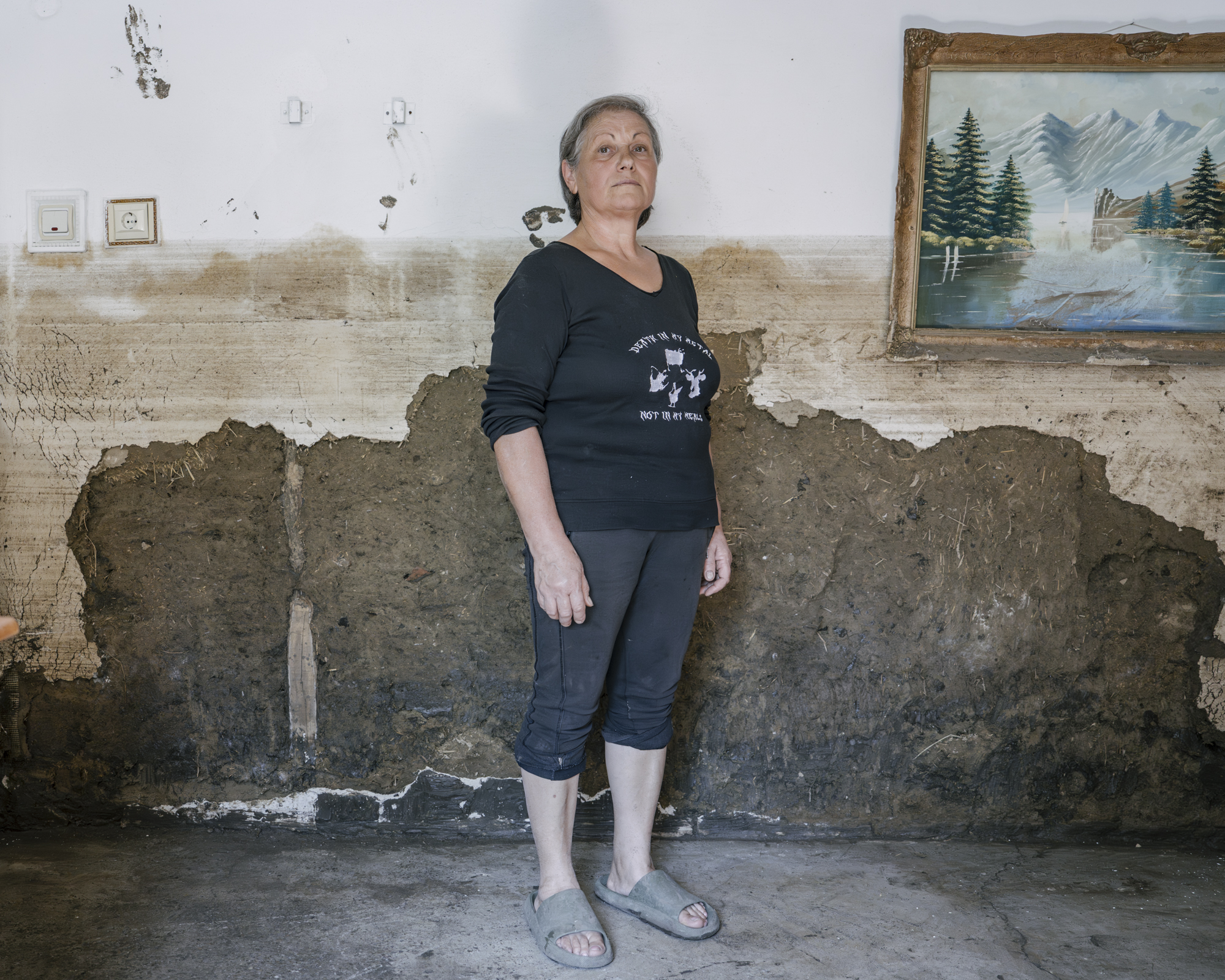
Margareta Drăgan, 59 years old, in her destroyed home in Slobozia Conachi after floods caused by the Boris storm had hit the area.
On the night of Friday, September 13-14, Margareta Drăgan was home alone with her bedridden 93-year-old mother. Her husband was working
the night shift. Around two in the morning, it started thundering, lightning, and raining. When the water entered the yard, the shed, and the car,
Margareta panicked. She called her husband. “I’ll try to come home,” he said and got in the car. He stopped at the dispensary in Slobozia
Conachi, where he could no longer drive through. “He walked through the water, wearing boots, although the boots were useless,” she recounts.
The water reached above his knees, and Nelu is a tall man. “Thank goodness he got home and was with me when the Suhurlui (river) and the
floodwaters came. If he hadn’t been there, I don’t think I would have endured,” Margareta says.
From the first thunderclaps, they lost electricity. If it hadn’t been dark, they might have been able to save some belongings. The flashlight ran out
of batteries. “We couldn’t see anything; it was pitch black, only glimpses when the lightning flashed,” she recalls. When the water began to enter
the house, they lifted “mămăița” (her mother) onto the wheelchair. When the water reached her seat, they placed her on the armrest of the
couch. Even there, the water reached her. “The poor thing sat with her bottom in the water,” says Margareta. They called 112, and eventually, a
team of firefighters arrived with a boat.
“The rescuers couldn’t get past the fence. They used a floating pallet, placed mămăița on it. They wanted to take me swimming, but I’m terrified
of water and couldn’t. I said, ‘I won’t leave my husband alone.'”
They stood in the cold water, filled with oil stains, praying it wouldn’t rise further. They kept looking at the tall fence as a reference point until it
disappeared beneath the water. They lost phone signal and couldn’t communicate with anyone. Relatives in the village, worried, sent rescuers
again. “They came back and took us along with our dogs. And that’s how we escaped,” says Margareta.
Margareta and Nelu Drăgan have lived their entire lives in Slobozia Conachi. They enjoyed rural life, working hard, and having everything they
needed. In 2015, after the floods of two years prior, they built a new house near the old structures. “We didn’t know what was going to happen to
us, so many times in a row,” she adds.
On Sunday, back in her waterlogged yard, despair overtook Margareta. “I felt powerless, exhausted,” she says, her eyes welling up. “We worked
so hard, both of us. I can’t even tell you. And we lost everything. Everything is gone. Everything!”
Their new furniture fell apart, wardrobes toppled, mattresses soaked, and the TVs and other appliances were ruined. Clothes and the car were
filled with mud. Of their 63 hens, only 19 survived; the rest were found dead in the yard. Miraculously, their pig survived.
“I didn’t think it would all go, be destroyed. I just wanted us to survive. In those moments, all I could think about was our lives,” Margareta
recalls. She believes she had a panic attack but credits her husband’s encouragement for getting through. “What else could we save? That was it.
We thought of the pig, the poultry, but at that moment, we knew everything else was gone.”
Over time, she hopes to rebuild her life. “We’ll take it as it comes. Maybe this was our fate; I don’t know what to say,” she adds. Pragmatic, they
have some savings and plan to work again. “We never went on trips or vacations; we always stayed here,” Margareta says. “With mămăița to care
for and farming tasks to do year-round, there was always something needing attention. We never found even a week for ourselves. Always here.
But now, I want a vacation. Once the house is somewhat liveable and the mud is gone, I want at least three days in the mountains. I love the
mountains. I don’t like water, the sea. The mountains and going higher. Clean air, greenery. That’s why we stayed in the countryside. I love
nature and always will.”
Margareta has never considered moving. Their two children, who live in Iași, have repeatedly invited them to join them. “We can’t part with our
birthplace; our roots are here, our parents are buried here,” she says. However, she admits that if, after the 2013 floods, someone had warned
them that such disasters would become more frequent and severe, they would not have built their house there. “I would have gone elsewhere,
found a safer spot, and built there. But no one came to instil that fear. Leave because worse will come.”
Margareta experienced moments of terror. Things must change, she insists. “All the mayors in this area should put pressure on Parliament. They
should go there month after month, remind them because now, yes, they see us suffering, they come and help, but then they forget about us. We
people, too, should unite, speak out, and share the nightmare we’ve lived through. Maybe we’ll move them, stir some compassion, and they’ll
start doing something. A well-thought-out project to prevent such devastation. It should have been done long ago. But nothing has been done.”
Slobozia Conachi, Romania, September 24th, 2024
Beyond the waters 12
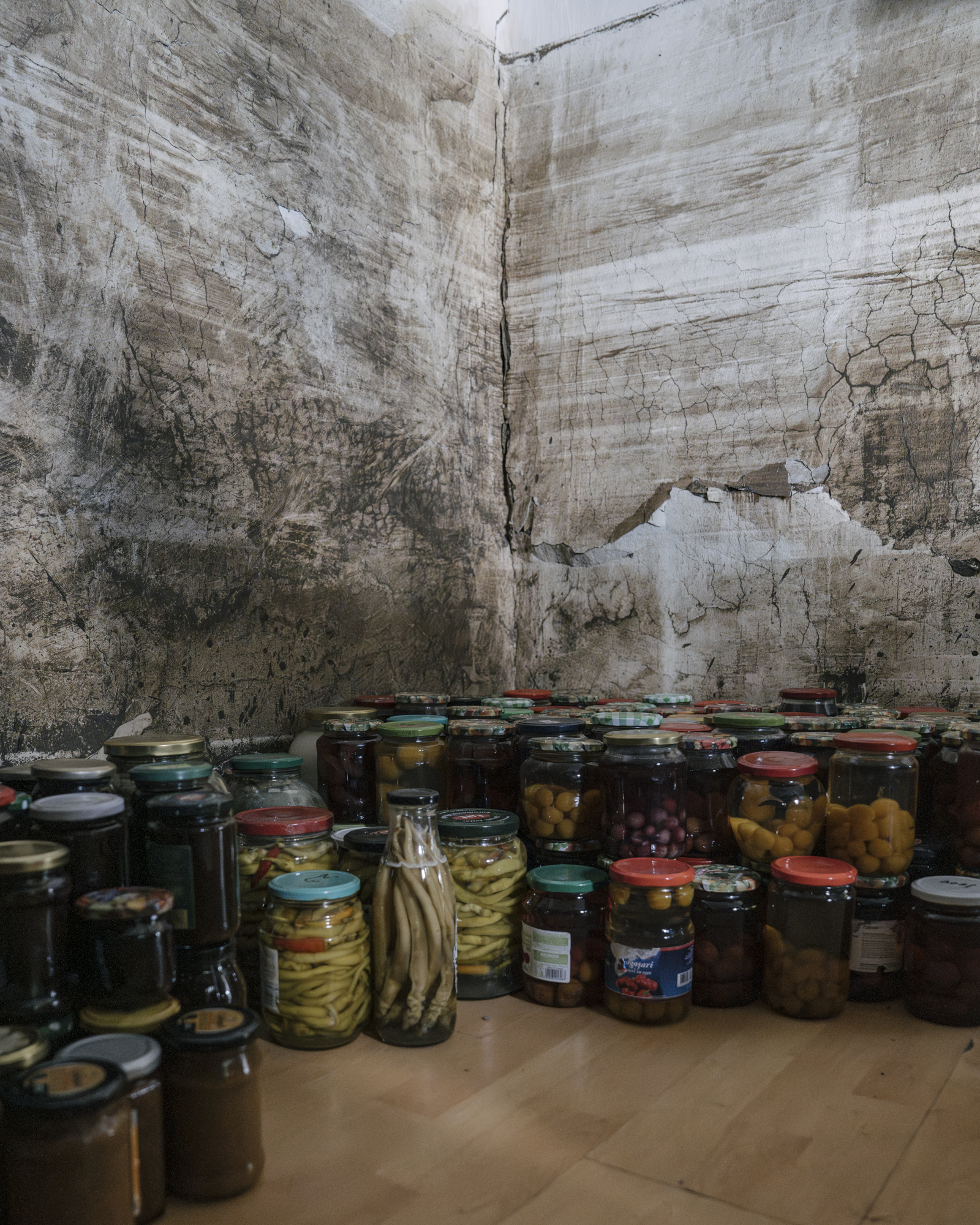
Margareta Dragan’s canned fruits and vegetables in the storage room that had been completely flooded. With appliances ruined and the garden under mud, these come in handy in desperate times.